
Teaching Kindness to Insects and Birds
Caring for small creatures builds empathy, curiosity, and ethical reasoning. Here is how to help your child observe, wonder, and treat the natural world with genuine care.
Children are born curious about small creatures. A toddler's face when they encounter their first worm, a preschooler's careful examination of a ladybird on a leaf — this instinct toward attention and wonder is exactly right. The job of the caregiver is to shape that curiosity into care, and in doing so, help build something larger: an ethic of kindness toward living things.
Why small creatures matter
Kindness to insects and birds is not a trivial lesson. It is the beginning of ethical reasoning about living things — about what has value, what deserves care, what our responsibilities are toward other creatures.
Children who learn to treat small creatures gently — to look without grabbing, to watch without harming, to redirect when their curiosity tips into something rougher — are practising capacities that will transfer. The child who learns to be careful with a worm is building the same muscle as the child who learns to be careful with a friend's feelings.
This is not a metaphor. Studies on the development of empathy consistently show that caring for animals — including small ones — supports the development of perspective-taking, emotional regulation, and prosocial behaviour.
New Zealand's particular gifts
Aotearoa is an extraordinary place to develop this kind of relationship with the natural world. Some of what is available even in suburban gardens:
- ✓**Wētā** — uniquely New Zealand, large and impressive, and genuinely fascinating to observe for children who approach with curiosity rather than fear.
- ✓**Pīwakawaka (fantail)** — often follows people through gardens and bush, making close observation easy and joyful.
- ✓**Tūī and kererū** — frequent suburban gardens where trees are flowering. Learning to identify them by sight and sound is both a nature skill and a te reo opportunity.
- ✓**Earthworms** — universally available, completely safe, and a perfect starting point for small hands.
- ✓**Snails** — slow enough to examine thoroughly, with shells that reward close attention.
- ✓**Bees on flowers** — worth teaching calm observation of. A child who watches a bee with stillness and genuine interest has learned something important.
The activities library has several ideas for nature observation and wildlife-friendly activities that work in gardens, parks, and bush walks.
Teaching gentle observation
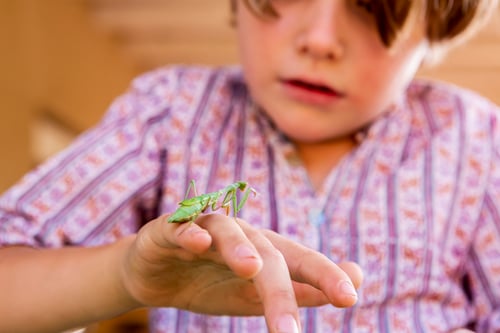
The skills of gentle observation — being still, moving slowly, looking without touching — are worth teaching explicitly. Young children naturally want to grab. Redirect with language: let's watch what it does. Can we see where it's going? What do you think it's feeling?
These questions are not rhetorical. When you model genuine curiosity about a creature — I wonder why it's going that direction — you are demonstrating that small things are worth wondering about. That practice of wondering is the foundation of scientific thinking and ethical reflection.
Touching can be appropriate, with guidance: we can put out a finger very slowly and see if the worm wants to go onto it. This gives the child agency within a frame of care, rather than a flat prohibition that does not explain itself.
What to do when it goes wrong
Children are sometimes rough with small creatures — squishing, over-handling, accidentally causing harm. This is normal developmental behaviour, not a sign of cruelty. The response that works is calm and matter-of-fact: that hurt the worm. Next time let's just watch. Can we find another one and see if we can help it along?
Attributing feelings to small creatures — the beetle was probably frightened — is a useful teaching tool for building empathy, even though we cannot know exactly what insects experience. The habit of wondering about another creature's perspective is worth building early.
Modelling care is more powerful than instruction. When your child sees you carefully relocate a spider rather than killing it, or stop to watch a bird for a moment, or name the fantail that has appeared in the garden — they absorb that attentiveness.
Bird feeders and gardens as ongoing practice
A simple bird feeder in your garden or on your balcony creates ongoing opportunities for observation, care, and wonder. Filling it regularly, watching what comes, learning the names of visitors — this is a small but consistent practice of kindness toward living things.
A container garden — even on a balcony — can attract bees and insects, giving children regular access to creatures they can observe. Growing something from seed and watching what comes to visit it is another form of this practice.
Today's activity in Tiny Steps sometimes includes nature observation ideas that are easy to extend into conversations about the creatures you find.
The long arc
A child who grows up treating small creatures with care and curiosity has something valuable: a sense that living things matter, that they deserve attention, that the world is full of small wonders worth protecting. These are not small things. They are part of how a kind person forms.

Written by
Tiny Steps programme team
Part of the Vector Group Charitable Trust Resilience Programme. Tiny Steps shares practical, educational content for whānau in Aotearoa.
Ready for today's tiny steps?
Open Today for five gentle ideas you can try with your whānau.