
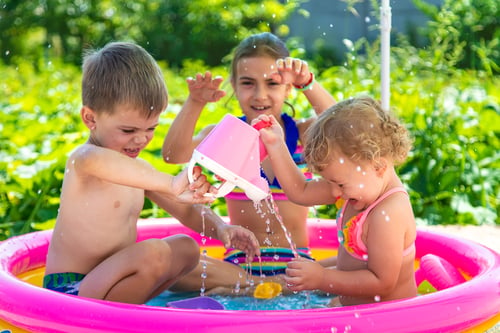
Summer water play with simple rules
A hose. A paddling pool. A bucket. Water is the best summer material for young tamariki. Simple, clear rules don't kill the fun — they make it possible.
The best toy for summer
A hose. A paddling pool. A bucket. A watering can pointed in the wrong direction. Water is the ultimate summer material for young children: endlessly manipulable, instantly cooling, and satisfying in a sensory way that almost nothing else matches.
Pour water, it flows. Block it, it backs up. Cup it with your hands, it escapes through your fingers. Splash it on the ground, it makes a new puddle. Drop a stone in it, there are rings. Water responds to every action, and it does so without judgement and without ever running out of ideas.
Why rules help rather than hinder
Simple, clear rules about water play do not kill the fun. They make it possible. Without them, a summer afternoon can become anxious and fraught — one child splashing another who didn't want to be splashed, water tracking through the house, shoes that were meant to stay dry now soaked.
With clear rules established before you start, everyone relaxes. A few that work for many families:
- ✓Water play happens in the garden (or a designated outdoor space), not inside.
- ✓Adults are present and watching, not just nearby. For any water with depth, this is not flexible.
- ✓Everyone knows the rules before getting in. Go through them at the start, briefly and warmly — not as a lecture, just as the shared agreement.
- ✓Wet clothes come off at the door before coming inside. This one saves a great deal of mopping.
Sun safety in Aotearoa summers
New Zealand has some of the highest UV levels in the world, including on days that feel mild or partly cloudy. Skin damage can happen in under twenty minutes of unprotected outdoor time during peak UV hours.
For summer water play, apply sunscreen before you go out — not once you are already outside and the children are already running. A UV protective swimsuit or rashie reduces the sunscreen-reapplication burden significantly. A hat that actually stays on is worth the money.
For clear guidance on protecting young children from UV, Healthline NZ has up-to-date sun safety information.
On supervision near water
Any water deeper than a few centimetres requires active adult supervision for children under five. This is not alarmist — it is a simple safety reality. A paddling pool left unattended for a few minutes is a risk, even for children who can swim.
The rule is simple and non-negotiable: if there is water play with depth, an adult is watching. Not reading nearby. Not checking a phone. Watching.
This is especially true for paddling pools, which can be left set up in a garden and accessed without adult knowledge. Empty the pool when water play is finished for the day. This is the easiest safety step available.
Simple water play ideas
You do not need a pool to have excellent water play:
- ✓A bucket of water with cups, funnels, and a sponge
- ✓A sprinkler on the lawn, run through repeatedly
- ✓Washing toy cars or plastic animals with a soapy cloth
- ✓A washing-up basin on a low table, with a cloth for the inevitable overflow
- ✓Filling and emptying containers of different sizes — genuinely absorbing for toddlers
- ✓Watering the garden (actually useful and satisfying)
The simple joy of it
Have a change of clothes ready. Accept that wet is wet. Enjoy the summer.
For more outdoor activity ideas across the seasons, explore our activities section or browse our summer resource packs.
Water play and language
Water play is also a language laboratory. The vocabulary of water — pour, flow, drip, splash, swirl, overflow, evaporate, freeze, melt — is rich and physical. Children who play with water in varied ways, with an adult who names what they are observing, accumulate this vocabulary naturally.
'Look — it's overflowing.' 'That one is dripping faster.' 'If we pour it back and forth, what happens?' These are not formal science lessons. They are conversations embedded in play, and they are how language and physical understanding develop together.
After the play
The transition out of water play — the towel, the dry clothes, the warmth — is a ritual in itself. On hot summer days in Aotearoa, the move from water to dry can happen several times. This is fine. Each transition, handled calmly and consistently, adds to a child's ability to shift between states without a battle.
Have the towels ready. Expect the transition to take a few minutes. End with something warm — a drink, a snack, a rest in the shade.
Explore our full summer activity library or browse our safety and outdoor packs.

Written by
Tiny Steps programme team
Part of the Vector Group Charitable Trust Resilience Programme. Tiny Steps shares practical, educational content for whānau in Aotearoa.
Ready for today's tiny steps?
Open Today for five gentle ideas you can try with your whānau.