
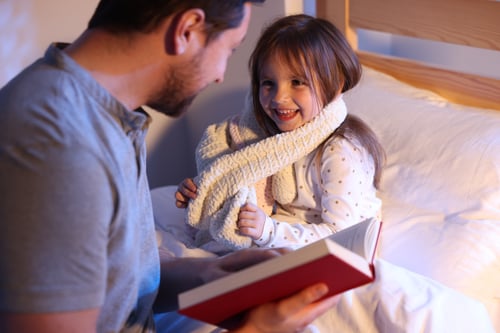
Stories before sleep without battles
Stories before bed should be one of the most connecting moments of the day. For some families they are. For others they've become a site of negotiation. What helps.
When stories become a battlefield
The scene: it is 7:45pm. You have read two books. Your child wants a third. You say no. They cry. You are too tired to hold the line or too tired not to, and either way the night ends with someone upset.
Stories before bed should be one of the most connecting moments of the day. For many families, they are. For others, they have gradually become a site of negotiation: one more, a longer one, that one instead, I don't like that one, stalling, refusal, tears.
The ritual over the battle
Stories work best when they are predictable and bounded. The elements that make a bedtime story routine actually settle a child:
- ✓The same time each night — before lights-out, after teeth
- ✓A consistent number of books (two is a common sweet spot)
- ✓The same ending: lamp dimmed, tuck-in, a brief goodnight phrase
- ✓A warm but unhurried pace — not rushed, not stalling
Children feel safe in repetition. The same time, the same place, a consistent number of books, always ending the same way. Children feel safe in repetition. Predictability is calming. The ritual itself signals: we are winding down, sleep is coming, this is the shape of the ending.
When stories are negotiable — when the number, the order, and the ending are all up for discussion — they stop functioning as a calming ritual and start functioning as an arena. The calm at the end of the day needs a container, and that container is the routine.
Letting the child choose — within the container
Within the clear boundary (two books, then lights dim), give real choice: 'You choose the first book, I'll choose the second.' Or: 'Here are three books — which two?' Real choice within a clear container is satisfying to a child and doesn't undermine the structure.
Children who have agency within the ritual push back far less on the ritual itself.
On the same book again, and again
If your child asks for the same book for the fifteenth night in a row, read it again. Repetition in stories serves several real functions: it builds vocabulary (children hear the same words and phrases until they own them), it creates security (the familiar story is itself calming), and it allows a child to fully inhabit a story — to know what is coming, to feel the pleasure of anticipation.
The request for the same book again is not a failure of literary variety. It is a sign that the book is doing something important.
Reading aloud itself
The physical closeness at story time — a child leaning against you, both of you focused on the same page — is irreplaceable. Decades of research on early literacy and language shows consistently that being read to, regularly and warmly, is one of the most significant investments a caregiver can make in a child's language.
Not because of the vocabulary (though that matters), but because of the attention. You are giving them your full, unhurried attention, and they know it. That is the real gift of story time.
On the nights when battles win
Some nights you are too tired, or they are too tired, and the whole thing falls apart. A screen or some quiet music becomes the bridge to sleep, the books stay on the shelf, and nobody reads anything.
This does not undo every other night. It is one night. Be gentle with yourself about it.
A library card as infrastructure
A public library card — free in all NZ public libraries — is one of the most practical tools for sustaining story time without buying new books constantly. A fresh selection every week or two keeps the shelf interesting without the expense. Let your child choose their own books at the library. Their choices will sometimes surprise you.
For more on sleep, language, and evening routines, visit KidsHealth NZ or explore today's Tiny Steps suggestions.
When older children read to younger ones
In households with more than one child, the older child reading to (or making up stories for) a younger sibling is one of the best possible developments. The reader practises fluency and expression. The listener gets the warmth of a known sibling voice. The caregiver gets a moment of relief.
This does not happen automatically. It is worth actively creating the opportunity: 'Would you like to tell your sister one of the stories from your head?' The stories an older child invents for a younger sibling are often extraordinary — vivid, funny, and exactly pitched for their audience.
For library card information and reading support, visit KidsHealth NZ or sign up to Tiny Steps for weekly reading and language ideas.

Written by
Tiny Steps programme team
Part of the Vector Group Charitable Trust Resilience Programme. Tiny Steps shares practical, educational content for whānau in Aotearoa.
Ready for today's tiny steps?
Open Today for five gentle ideas you can try with your whānau.