
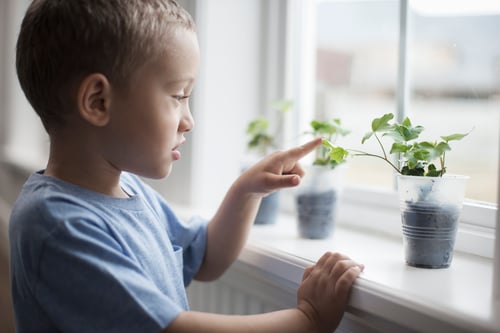
Spring window-sill sprouting
A seed pressed into soil and watered every morning is one of the slowest, most grounding things you can do with a young child in spring. And when it appears — the first green shoot — it is genuinely magical.
Why the window sill
Spring arrives in Aotearoa gradually — a warmer afternoon here, a longer evening there, the first daffodils in the park. For young tamariki, the season shift is felt rather than understood: the world is getting warmer and lighter, and things are starting to grow.
The window sill is one of the most accessible places to participate in this directly. A seed pressed into damp soil on a sunny window sill is doing something genuinely extraordinary: gathering energy from the same light that has lengthened since the solstice, building structure from almost nothing. The window sill makes this visible and close.
What to grow
Simple seeds that sprout reliably and quickly are the best starting point for young children:
- ✓Mung beans: ready in three to five days, just rinsed in a jar of water — no soil needed. Watch the root emerge first, then the shoot.
- ✓Cress: sown on damp cotton wool or paper towels on a small tray. Germinates in days, ready to eat in about a week. Has a peppery taste that many children find surprising and delightful.
- ✓Broad beans: press one against the inside of a glass jar filled with damp paper towel so the root development is completely visible. Children find this almost unbearably exciting.
- ✓Sunflowers: slower, but the dramatic scale of the result makes the waiting worthwhile. Plant in a larger pot and move outside when strong.
- ✓Peas: germinate well on a window sill, then move outside or into the garden when they have their first true leaves.
The daily routine
Watering is the child's job. A small watering can, a cup with a pour spout, or even a misting spray bottle. Every morning, a little water. This is the practice.
This is not primarily a lesson in plant biology. It is a lesson in care and consistency: things grow when they are attended to, day after day. A missed day shows up. A week of care shows up. The relationship between attention and growth is visible.
When things don't grow
Some seeds won't sprout. Some seedlings will be accidentally overwatered, or knocked off the sill, or eaten by a sibling. This is fine and honest. 'That one didn't make it — should we try again?' is a complete and sufficient response.
Resisting the urge to replace dead seedlings secretly in the night is worth the small effort. The reality that not everything survives is part of the lesson, and young children can hold it if you hold it calmly with them.
Following the seed all the way
When seedlings are strong enough, plant them out together — in a garden bed, a pot on the balcony, a hanging planter. Follow the plant through its full life: the leaves, the flowers, the fruit or seeds. Eating something your child helped grow from a seed is one of those experiences that lands somewhere deep and stays.
Spring as a beginning
For young tamariki, spring sprouting is one way of being in the season — of participating in the growth that is happening everywhere, not just observing it. The seed on the window sill is small. The act of attending to it daily is not.
For more seasonal activities, explore our spring and summer packs or browse this week's ideas. Plunket also has year-round guidance on connecting tamariki with the natural world.
Tracking growth together
A simple growth chart — a sticky note or a strip of paper beside the pot, with marks made every few days — turns the sprouting into a data story. How tall today? How much taller than yesterday? This is early mathematical thinking, but more than that, it is a record of care: every mark represents a day that someone watered this thing.
When the seedling is eventually planted out or given away or eaten, the growth chart remains. It is a small history of attention paid to a living thing.
On giving seeds as gifts
A seed packet is one of the best gifts you can give a young child — better than most toys, in terms of lasting engagement. A packet of peas, a packet of sunflowers, or a small bag of bean seeds with a little pot and some soil is a complete activity: the preparation, the planting, the waiting, the growing. It engages a child across weeks, not hours.
Seeds as gifts from young children to other people — grandparents, teachers, neighbours — are also deeply satisfying to give. A seedling grown with care and delivered with pride is a gesture that lands well for almost any recipient.
For more spring activity ideas, browse our seasonal packs or sign up to Tiny Steps.

Written by
Tiny Steps programme team
Part of the Vector Group Charitable Trust Resilience Programme. Tiny Steps shares practical, educational content for whānau in Aotearoa.
Ready for today's tiny steps?
Open Today for five gentle ideas you can try with your whānau.