Songs and Nonsense Talk for Language from Day One
Long before your baby says a word, they are building the architecture of language — and your voice, in all its silliness, is the best tool they have.
The Neuroscience of Nonsense
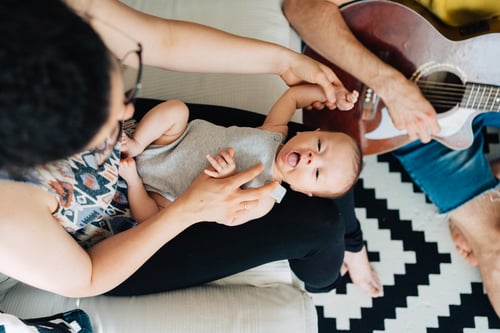
In the first days of a baby's life, their brain is already processing language. Not the meaning of words — that comes much later — but the sounds, rhythms, patterns, and emotional tones of the language around them. Each time you speak to your baby, sing to them, narrate your day in a silly voice, or repeat a sound they have made back to them, you are contributing to the construction of something extraordinary: a language system that will serve them for life.
This is not metaphor. The neural pathways for language are actively forming in the first months and years of life, and they are shaped, significantly, by the quantity and quality of language that a baby hears in their environment. Research consistently shows that babies who experience rich, responsive language from early in life develop larger vocabularies, stronger reading skills, and better academic outcomes.
The implication is both exciting and completely undramatic: talking to your baby, from the very first day, is one of the most valuable things you can do for their development. And you do not need to be interesting.
What Counts as Language-Rich
Parents sometimes imagine that language-rich means educational — that they should be naming shapes and colours, introducing vocabulary in organised ways, playing specific learning games. This is not what the research describes. Language-rich in the first year means:
- ✓**Quantity.** Simply talking, a lot. Narrating what you are doing. Describing what you see. Commenting on the day. The more words a baby hears in a warm, responsive context, the better.
- ✓**Responsiveness.** Talking in response to the baby's sounds. When they make a noise, making a noise back. When they look at something, naming it. This back-and-forth — what researchers call 'serve and return' — is the conversational pattern that builds language competence.
- ✓**Warmth.** Language delivered with positive emotion is processed differently than language delivered flatly. The warm, slightly silly, exaggerated tone that adults naturally adopt with babies — sometimes called 'parentese' — is actually ideal for language learning, not embarrassing.
Songs in Particular
Song has been part of how adults communicate with babies across every culture and throughout recorded history, which is itself a form of evidence. Songs offer babies something slightly different from speech: the rhythm is more regular, the melody is memorable, and the repetition — the same song, sung the same way, over and over — is exactly what learning brains need.
You do not need a repertoire of educational songs. You need:
- ✓The songs you already know and can sing without looking anything up — fragments of pop songs, Christmas carols, waiata, hymns, the theme from a TV show you used to love
- ✓The same song, sung many times, rather than many songs sung once each
- ✓Willingness to be silly — the sillier the better, for both of you
If you have te reo Māori waiata in your repertoire or your family background, use them freely. If you do not, there are simple, common waiata — E Roto i te Aroha, Tūtū Te Puehu — that can be learned easily and that weave te reo naturally into a baby's early language environment. KidsHealth NZ has resources on language development that include some guidance for bilingual and multilingual homes.
Nonsense Is Not Nothing
The clicking sounds you make when you are changing a nappy. The running commentary on the interesting properties of a cloud. The extended dramatic narrative about whether the cat should be allowed on the couch. The song you improvise about getting dressed. None of this is nothing.
All of it is contributing to a baby who grows up knowing that language is a tool for connection, play, and expressing the contents of the mind. That foundational knowledge — that words are for sharing experience with other people — precedes vocabulary and grammar and reading. It is built in the nonsense first.
The Conversation That Has Already Begun
By the time your baby says their first word — usually somewhere between ten and fourteen months, with enormous variation — they will have heard hundreds of thousands of words from the people around them. That first word is not the beginning of language development. It is the visible tip of an enormous invisible structure that you have been building together for almost a year.
The daily activities in Tiny Steps include many prompts around language and speech, all built on this understanding. The today page often offers a specific small idea — something to say, sing, or try — that takes less than a minute and contributes to that structure. Not because you needed to be reminded to talk to your baby. But because having a specific invitation sometimes makes it more likely you will do it at a particular moment, and particular moments add up.
Written by
Tiny Steps programme team
Part of the Vector Group Charitable Trust Resilience Programme. Tiny Steps shares practical, educational content for whānau in Aotearoa.
Ready for today's tiny steps?
Open Today for five gentle ideas you can try with your whānau.