
Soft Playdates That Don't Require Leaving Home
Connection with other new parents matters, but leaving the house with a newborn is a significant undertaking. Here's how to build community from your couch.
The Isolation Nobody Warned You About
Parenthood, especially in the early weeks, can be unexpectedly isolating. You are surrounded by busyness — the feeds, the naps, the laundry, the visitors — and also quietly alone in a way that is hard to explain to people who have not been through it.
The particular loneliness is this: you are having an experience that is all-consuming and unprecedented for you, and most of the people around you are continuing their ordinary lives at ordinary pace. Your friendship group is at work. Your partner, if you have one, may have returned to work. The world outside has not paused for your transformation.
Other new parents are the people who understand. And the question becomes how to find and spend time with them when the idea of organising anything beyond the next feed feels ambitious.
Why Leaving Home Is Hard
Getting out of the house with a newborn is not difficult in the way that climbing a mountain is difficult. It is difficult in the way that doing fifteen medium-complexity tasks in the correct sequence while sleep-deprived is difficult. The timing of feeds. The nappy situation. The fact that the baby always seems to need something at the exact moment you are trying to put your shoes on. The pram that requires both hands when you also need to carry the bag.
None of this is insurmountable. But it means that the soft playdate — the one that does not require leaving home — has a genuine advantage in the early weeks. It is available.
What a Soft Playdate Looks Like
A soft playdate in the newborn period is not really about the babies, who are largely unaware of each other and unconcerned about social interaction. It is about the parents. Here is what it can look like:
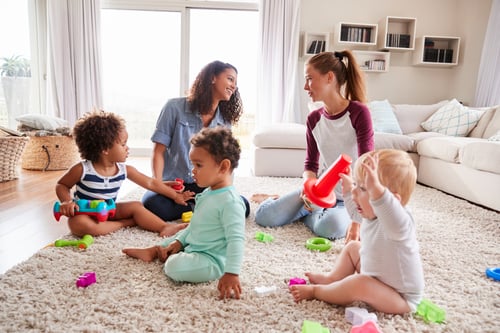
- ✓**The couch playdate.** Two or three parents, on someone's couch, with babies in their arms or on blankets on the floor, drinking hot drinks that go cold, talking about anything. No activities planned. No agenda. Just company.
- ✓**The walk-to-yours.** One parent walks to another's house. The host does not need to have a clean house. The host only needs to open the door.
- ✓**The video call with a purpose.** Not a check-in call but a call where you are both also doing something — eating lunch, feeding, folding laundry. The parallel presence of another person doing the same thing you are doing is its own comfort.
- ✓**The text thread that goes all day.** A small group of parents who are all awake at overlapping hours and willing to narrate the day's chaos in real time. This is not substitute for in-person company but it is not nothing, especially at 2am.
Finding Your People
If you are new to an area, or if your pre-baby friend group does not include many parents, finding other new parents requires some intentional action:
- ✓Plunket groups and coffee mornings exist specifically for this and are run throughout New Zealand. Plunket can connect you with groups in your area.
- ✓Community Facebook groups for parents in your suburb or city can be a surprisingly useful way to find people nearby in similar stages.
- ✓Baby and parent classes — yoga, swim, play — create repeated contact with the same people, which is how acquaintance becomes friendship.
- ✓Your midwife or Well Child provider may know of local groups worth attending.
Hosting Without Performance
If you are hosting, the most important thing is not the state of your house. The most important thing is that your front door opens and someone else can come in.
Tell people explicitly: 'Come over, the house is a mess and I don't care.' Most new parents will find this a relief rather than a concern. The social norm around having a clean and orderly house for guests is a pre-baby norm, and it is worth explicitly suspending it for this season.
Offer tea or coffee, or don't. Have snacks, or don't. The conversation and the company are the point.
Tiny Steps has activity ideas that work beautifully as soft playdate activities — small, gentle things that give the adults something to do and talk about without requiring any preparation. The daily prompts can serve as a conversation starter with another parent: 'Tiny Steps suggested something interesting today — do you think it's true?'
Connection is the resource. The soft playdate is the vehicle. Both are worth more than they are given credit for.

Written by
Tiny Steps programme team
Part of the Vector Group Charitable Trust Resilience Programme. Tiny Steps shares practical, educational content for whānau in Aotearoa.
Ready for today's tiny steps?
Open Today for five gentle ideas you can try with your whānau.