
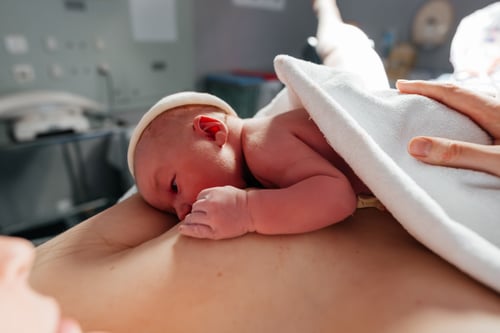
Skin-to-Skin Beyond the Newborn Brochure
Skin-to-skin contact is presented as a birth-room practice. It is actually one of the most powerful tools you have for months — and it works for anyone in the family.
The Brochure Version
Most New Zealand parents encounter skin-to-skin contact in the birth room, often before the cord is cut: the baby is placed on the chest, and there is a period of holding that the midwife calls 'skin to skin.' It is recommended. It is documented. And then, in the busyness of everything that follows, it can recede into the early notes as something that happened at the beginning, rather than something available to you for months.
This is a missed opportunity. Skin-to-skin contact is not a birth room procedure. It is one of the most consistent, low-cost, research-supported tools for newborn regulation, bonding, and parental confidence available in the first months of a baby's life.
What It Actually Does
When a baby is held skin-to-skin — chest against chest, with warmth and a heartbeat — several things happen simultaneously:
- ✓The baby's temperature regulates more reliably than in a cot with blankets
- ✓Heart rate and breathing tend to stabilise
- ✓Cortisol (stress hormone) levels in the baby decrease
- ✓The caregiver's oxytocin levels rise, supporting the bonding process
- ✓Feeding cues become more readable, as the baby is awake but calm
- ✓For premature or medically fragile babies, the benefits are even more significant
None of this requires any equipment. It requires a chair, a blanket if it is cold, and a few minutes without a demanding agenda.
It Is Not Only for the Birthing Parent
Skin-to-skin works for partners, grandparents, and any trusted person who is part of the baby's close world. The regulation effects are similar regardless of who is doing the holding. For partners especially, skin-to-skin is one of the most powerful ways to build the felt sense of connection that can sometimes lag behind the birthing parent's bond.
A partner who holds a baby skin-to-skin in the first weeks — propped up in bed, baby on chest, both of them still — is not just providing care. They are building a relationship, neuron by neuron, in the specific language that newborns understand: warmth, heartbeat, smell, closeness.
For more on the benefits and safe practice of skin-to-skin across the newborn period, Plunket has clear and reliable guidance, including information on safe positioning.
When It Is Especially Useful
Skin-to-skin is not just for calm moments. It is often most useful precisely when things are hardest:
- ✓When a baby is unsettled and nothing else is working
- ✓During a feeding strike, when the closeness can gently encourage the baby to try again
- ✓When a parent is feeling disconnected or overwhelmed — the physical contact tends to shift the emotional state of both parties
This last point deserves emphasis. Skin-to-skin is also, quietly, a tool for the parent. The same hormonal response that benefits the baby — the oxytocin release, the cortisol reduction — benefits the caregiver too. On a hard afternoon, putting the baby on your chest and sitting still for ten minutes is not avoidance of the problem. It is often a direct response to it.
Making It a Habit Rather Than an Occasion
The most useful reframe is to stop treating skin-to-skin as a special practice and start treating it as one of the ordinary ways you can hold your baby. Not every feed. Not every day necessarily. But regularly enough that it is part of the texture of early parenthood rather than something you have to remember to do.
Some natural entry points:
- ✓After a bath, when the baby is warm and calm
- ✓During night feeds, when a quiet connection is sometimes easier than when the day is busy
- ✓When you arrive home after time away and want to reconnect quickly
- ✓On a day when the baby seems particularly fussy and you want to try something different
KidsHealth NZ has further reading at kidshealth.org.nz on newborn development and what babies need in the first months. The short version is that what they need most is proximity to the people who love them, delivered warmly and often. Skin-to-skin is one of the most direct ways of providing exactly that.
The activity ideas in Tiny Steps include many prompts around connection and closeness in the early months, all built on this same understanding: that the simplest things, done consistently, build what nothing else can.

Written by
Tiny Steps programme team
Part of the Vector Group Charitable Trust Resilience Programme. Tiny Steps shares practical, educational content for whānau in Aotearoa.
Ready for today's tiny steps?
Open Today for five gentle ideas you can try with your whānau.