
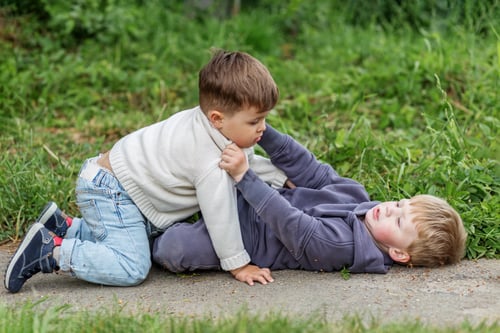
Sibling truce in five soft minutes
Siblings fight. This is not a failure — it is two different people with different needs and limited vocabulary, living in close quarters. Here's a soft approach to de-escalation.
Why they fight
Siblings fight because they are people. Two people who did not choose each other, who share space and attention and toys, who are at different stages of being able to manage their feelings, and who know each other well enough to find exactly the right button to push.
Sibling conflict is not a sign of a family in trouble. It is a sign of a family with more than one child. The fighting is not the problem. How it is handled — by the adults and eventually by the children themselves — is where the growth lives.
What five soft minutes looks like
This is not a formula. It is a direction: slow down, go quieter, use fewer words, and prioritise each child's nervous system over the logic of what happened.
When conflict escalates, try this sequence:
- ✓Separate with care, not anger. Get between them physically if needed — calmly, without grabbing. Put a hand on a shoulder. 'Hey. Come with me.'
- ✓Sit with each child individually for a moment before bringing them back together. This is not punishment. It is regulation. Two minutes apart, with a trusted adult nearby, is often enough to shift the chemistry.
- ✓Name the feeling, not the behaviour. 'You're really upset right now' lands better than 'you shouldn't have hit.'
- ✓Bring them back together with a choice or a shared task — 'I need two people to help me carry this' — rather than forcing a confrontation.
- ✓Let the truce be informal. Children often do not need a verbal resolution. Physical proximity again, a shared task, and they are frequently back to playing.
What does not help
- ✓Asking who started it. Nobody knows. Everyone knows. It doesn't help.
- ✓Insisting on an apology before reconnection. The apology, if it comes, should come after the nervous systems have settled.
- ✓Shaming either child publicly. 'Look what you've done to your sister' escalates, it does not repair.
- ✓Taking sides consistently. Even if one child's behaviour seems more clearly wrong, consistently allying with one child damages both relationships.
- ✓Ignoring until it becomes dangerous. Low-grade conflict can often be left. But adults need to stay aware enough to step in before it escalates to physical harm.
The bigger picture
Siblings who fight are also siblings who are learning how to navigate disagreement, express needs, tolerate frustration, and repair. These are the most important skills in any human relationship. The sandbox at home is the training ground.
Children in families where sibling conflict was handled with warmth and fairness — not perfectly, but with care — tend to develop stronger social skills than only children, because they had more practice at the hard work of getting along with someone you did not choose.
On your own feelings
Sibling conflict can be exhausting in a way that is hard to describe. The noise, the repetition, the sense that nothing you do makes a lasting difference. On the days when it is relentless, your job is not to fix it. It is to manage it well enough that nobody gets hurt, and to keep your own wellbeing intact enough to try again tomorrow.
For more on navigating behaviour with warmth, visit SKIP for strategies developed for New Zealand whānau, or explore our activity ideas for shared experiences that build connection between siblings.
The relationship between the siblings
Siblings do not just have a relationship with each parent. They have a relationship with each other — one that, if things go reasonably well, will be the longest relationship of their lives. The sibling bond, with all its friction and ferocity, is built in these ordinary clashes over trucks and turns and who touched who.
Your job is not to make them love each other perfectly. It is to create conditions where they can work it out, repair, and come back — over and over. The repair is the practice. Every time a sibling conflict moves through anger to resolution (however imperfect), a small deposit is made in the account of the relationship.
What help looks like from the outside
Some parents find it useful to narrate the dynamic rather than intervene in it: 'I wonder how you two can solve this.' This hands the problem back to the children and signals confidence in their capacity to manage it. It does not always work. But it is worth trying before escalating to adult-led resolution.
For guidance on sibling dynamics and family behaviour, visit SKIP or explore our whānau resources.

Written by
Tiny Steps programme team
Part of the Vector Group Charitable Trust Resilience Programme. Tiny Steps shares practical, educational content for whānau in Aotearoa.
Ready for today's tiny steps?
Open Today for five gentle ideas you can try with your whānau.