Practical skills: folding tea towels together
When you trust a young child with a real household task — imperfect fold and all — you are communicating something that play alone cannot: your contribution matters here.
What happens when children help with real tasks
There is a tendency in modern parenting to protect children from tasks that seem too hard, too boring, or too important to risk getting wrong. We do the dishes while they play nearby. We fold the laundry after they are in bed. We let them 'help' in ways that don't actually touch the real work.
But young children are wired to want to be useful. Not in a precious, aspirational way — in a deep, biological way. They want to participate in the life of the household. When we give them real work, they rise to it. And they feel something that is very hard to manufacture through play alone: competence.
Why tea towels
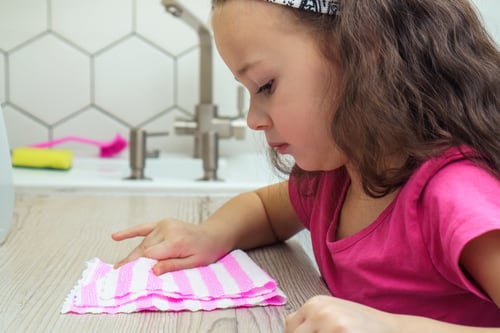
Folding tea towels is genuinely achievable for a two or three-year-old. The towel is light. The folds are forgiving. The result — a folded towel in a pile — is visible, real, and useful. There is nothing pretend about it.
Other accessible first tasks for under-fives:
- ✓Pairing socks by colour (a matching game and a useful job)
- ✓Wiping the table after a meal with a damp cloth
- ✓Carrying their own plate or cup to the sink
- ✓Putting cutlery (safe items only) into the drawer
- ✓Carrying folded items to the right room
How to do it together
Lay the towel flat on the table or floor. Show once how to fold it in half. Then hand it over.
The fold will not be perfect. That is correct.
Resist the urge to refold it in front of them. Accept the imperfect fold and put it in the pile with the others. The pile of tea towels is not the point. The child who helped is the point.
The word dignity
We use it deliberately. When you trust a child with a real task — not a toy version, not a pretend simulation — and you let the result stand, you are communicating something that matters:
Your contribution matters here. You are capable. You belong in this household as a working member, not just as someone who is cared for.
That is dignity. And it is available in an ordinary kitchen drawer.
On slowness and mess
Doing laundry with a two-year-old takes longer. Roughly twice as long. The table wipe leaves streaks. The sock drawer is not sorted the way you would sort it yourself. This is the real cost of working alongside young children: it is slower and less neat.
The long-term return on that investment — a child who grows up expecting to contribute, who does not experience household work as something that happens around them, who has a felt sense of their own usefulness — is large.
The bigger picture
Children who are given genuine household responsibilities from young tend to take them on more readily as they grow. The relationship between task and belonging is established early. When tidying or helping is part of the fabric of daily life from the very beginning, it does not later become a battle.
This is not about chores. It is about a child who understands themselves as someone who contributes — to this kitchen, to this family, to this household — because they always have.
Starting small
You do not need to restructure the household. Start with one task that a young child can genuinely do. Let them do it beside you, imperfectly, and accept the result with warmth. Do it again tomorrow. And the day after.
For more ideas on building practical skills alongside play, explore our activity suggestions or look through this week's ideas.
What children notice when they help
Children who help regularly with household tasks often develop a detailed map of their home that children who are kept separate from that work do not have. They know where things are stored and why. They know what is heavy and what is light. They know which jobs are done daily and which are done weekly.
This household knowledge is a form of literacy — knowing the grammar of the place you live. A child who helps in the kitchen knows the smell of what is cooking and the sound of it. A child who helps with laundry knows which clothes belong to whom. This knowledge is intimate and grounding.
On making it normal, not special
The risk of framing household contribution as a special activity is that it becomes something you only do when you have time and energy for it, rather than simply what this household does. The goal is ordinariness. Not 'today we are doing laundry together because it's a learning opportunity' — but 'I'm doing the laundry, come help if you want.'
The casual invitation, repeated often enough, becomes the expectation.
For more on practical skills and everyday family rhythms, explore our activity ideas.

Written by
Tiny Steps programme team
Part of the Vector Group Charitable Trust Resilience Programme. Tiny Steps shares practical, educational content for whānau in Aotearoa.
Ready for today's tiny steps?
Open Today for five gentle ideas you can try with your whānau.