
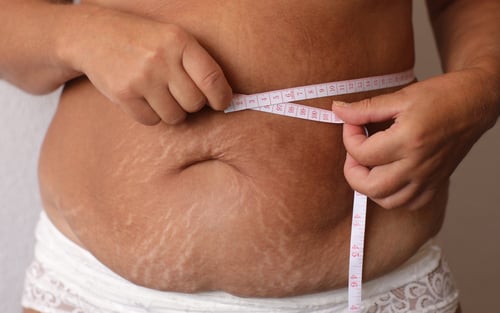
Postpartum Body Kindness Without Comparison
The postpartum body is not a before-and-after story. It is a body that did something extraordinary and is now continuing to do the work of sustaining a family.
The Story We Were Given
Somewhere in the last thirty years, the postpartum body became a project. The language shifted: 'bouncing back,' 'getting your body back,' 'snapping back to pre-baby.' Magazine covers showed women who appeared unchanged by the experience of growing and birthing a person. Social media made this comparison available not once a month from a newsstand, but continuously, algorithmically, in the palm of your hand.
The story this creates is straightforward and damaging: the postpartum body is a problem to be solved, and the benchmark is the body you had before. By this logic, your body, in the weeks and months after giving birth, is in a state of failure to be remedied.
This is not true. It is not accurate biology, and it is not a useful framework for living in your body after you have given birth.
What Has Actually Happened
In the weeks after birth, your body is undergoing a significant series of changes, none of which are visible from the outside in the way a before-and-after photo suggests:
- ✓If you gave birth vaginally, tissues are healing and muscle tone in the pelvic floor is rebuilding — a process that takes months and is not linear.
- ✓If you had a caesarean section, you have a significant abdominal wound that is healing in layers, with the deeper layers taking considerably longer than the surface scar.
- ✓Your uterus is contracting back to its usual size, a process that can take six weeks and is sometimes felt as cramping, particularly during breastfeeding.
- ✓Hormones are shifting dramatically, with some of the changes (especially in the first week) being among the most significant hormonal events of an adult life.
- ✓If you are breastfeeding, your body is producing milk, which requires significant caloric expenditure and has its own hormonal profile that can affect mood, joints, and body composition.
All of this is happening underneath the surface of whatever your body looks like in the mirror.
Comparison as a Specific Harm
Comparison in the postpartum period causes harm in a specific way: it redirects attention from what your body is actually doing toward what it looks like relative to an external standard. This is not a useful redirection. It is a distraction from the task, which is recovery and care.
Every body has a different starting point, a different birth experience, different genetics, different breastfeeding choices, different sleep, different support, different stress. The person whose body 'bounces back' in six weeks is not working harder or caring more than the person whose body takes eighteen months. They have a different body, period.
What Body Kindness Actually Means
Body kindness in the postpartum period is not about how the body looks. It is about how the body is treated:
- ✓Feeding it adequately. New parents, especially breastfeeding ones, often undereat because eating requires two free hands and an uninterrupted minute. Eating enough is a basic act of self-care with direct effects on recovery, milk supply, and mood.
- ✓Moving it gently and appropriately. Early postpartum movement is not 'getting fit' — it is restoration. Walking, gentle stretching, and specific pelvic floor work (ideally guided by a physiotherapist) are the relevant movement in the first months. A GP or physiotherapist can advise on the right timeline for your specific recovery.
- ✓Resting it when it asks. The urge to demonstrate resilience by not resting is understandable and counterproductive. The body heals during rest, not despite it.
- ✓Talking kindly to it, or at least not unkindly. The internal monologue about your own body has a way of becoming background noise that you live inside. It is worth occasionally auditing whether the noise is fair.
If you are experiencing significant distress about your body — thoughts that interfere with daily functioning, persistent disgust or despair — please speak with your GP or midwife. The Mental Health Foundation has resources for postpartum mental health, and body image concerns are within scope.
A Different Measure of Success
Your body grew a person. It sustained them. It brought them into the world and is continuing to care for them. By any reasonable measure, that is an extraordinary performance — not a failure requiring correction.
The daily ideas in Tiny Steps are built around this understanding. They do not ask you to be a particular size or shape. They ask you to show up, in whatever body you have today, and offer your family the things only you can offer them: your voice, your warmth, your attention, your specific and irreplaceable presence.

Written by
Tiny Steps programme team
Part of the Vector Group Charitable Trust Resilience Programme. Tiny Steps shares practical, educational content for whānau in Aotearoa.
Ready for today's tiny steps?
Open Today for five gentle ideas you can try with your whānau.