Playgrounds and patience with other tamariki
Put three two-year-olds near one digger truck and you have a social laboratory. Someone will grab, someone will cry, someone will watch. All three responses are normal.
The sandbox as a social laboratory
Put three two-year-olds near a single digger truck and you have one of the most useful social laboratories in existence. Someone will grab. Someone will cry. Someone will stand back and watch. All three responses are completely normal, and all three carry something to learn.
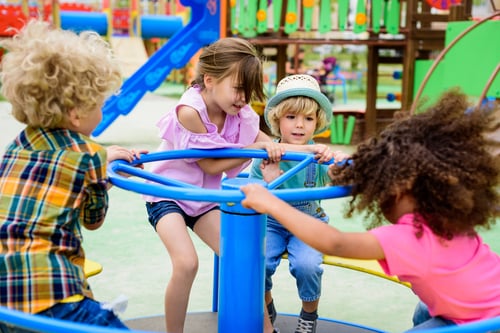
The playground is where young children begin the long, imperfect work of being in the world with other people — people who are not their family, who have not been briefed on their preferences, and who also want the swing.
What toddlers can and cannot manage socially
Sharing is genuinely hard for under-threes. The capacity for genuine sharing — voluntarily giving up something because someone else wants it, and feeling okay about that — typically emerges closer to age four or five. Before then, 'sharing' usually means 'giving up something I am currently using', which is uncomfortable for anyone at any age.
This does not mean there are no expectations. It means the expectations should match the developmental reality. 'Your turn, then his turn' is an accessible concept for a three-year-old. 'Be generous with your things' is not.
What adults can do at the playground
The temptation to over-manage playground dynamics — to narrate every interaction, adjudicate every conflict, and smooth every rough moment — is understandable and usually counterproductive.
More useful:
- ✓Stay present but resist directing every interaction. If the situation is not dangerous, give it a moment.
- ✓Narrate rather than judge: 'Oh, she wants a turn. What should we do?' opens a conversation without providing the answer.
- ✓Step in when physical safety is at risk. Otherwise, wait.
- ✓Avoid shaming language: 'That's not kind' is less useful than 'He's crying because that hurt him.'
- ✓Model the language you want them to develop: 'Can I have a turn?' 'I'm going to use it for two more minutes and then it's Hana's go.'
The value of the hard moments
Children who are allowed to navigate mild playground conflict — with adult presence but not adult control — are building something essential: the capacity to problem-solve in social situations without an adult doing it for them.
Watching a child stand their ground, negotiate a turn, or choose to walk away from a conflict that isn't worth it is satisfying in a way that the managed, smooth playground never is. These are real social skills, being built in real time.
When your child is the one who grabs or pushes
Take a breath. It is not a permanent character trait. Help them repair — 'Can you check if he's okay?' — keep your language warm and matter-of-fact, and move on. It will happen again, probably tomorrow, and that is fine.
If grabbing or pushing is frequent and intense, it may be worth a conversation with your early childhood teachers about what they are seeing and what support might help.
When your child is on the receiving end
Instinct says: fix it immediately, protect them, address the other child. This is understandable. But a child who sees their parent step in calmly — rather than anxiously or aggressively — and help them navigate the situation rather than remove them from it, learns something about their own capacity to handle hard moments.
You do not need to protect your child from every playground difficulty. You need to be close enough that they know you are there.
For more on navigating behaviour in social settings, visit SKIP for Aotearoa-based guidance, or explore our community activities for ideas that build social confidence.
Playgrounds with loose parts
The most socially rich playgrounds are often not the most elaborate ones. Playgrounds that include loose parts — sand, water, logs, stones, planks, tyres — invite more complex and collaborative play than fixed equipment alone. Children at a loose-parts playground negotiate, build together, assign roles, and manage conflict far more actively than children in a standard fixed-equipment playground.
If you have access to this kind of playground in your area, it is worth visiting regularly. The social complexity it generates is genuinely different.
What you cannot control
You cannot guarantee that every playground experience goes well. Some days another child will be unkind, or yours will be. Some days the dynamics will be painful to watch. The goal is not smooth playground experiences — it is a child who grows in their capacity to navigate rough ones, with you nearby.
For more on social play and community, explore our outdoor activities or visit SKIP for guidance on tamariki and social learning.

Written by
Tiny Steps programme team
Part of the Vector Group Charitable Trust Resilience Programme. Tiny Steps shares practical, educational content for whānau in Aotearoa.
Ready for today's tiny steps?
Open Today for five gentle ideas you can try with your whānau.