
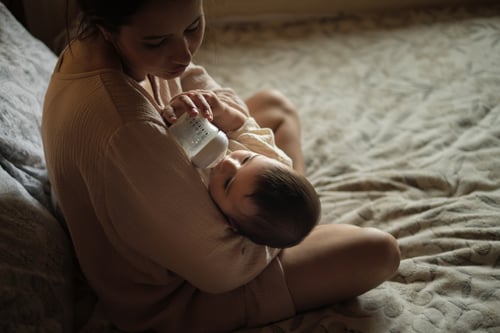
Night Feeds and Kindness to Yourself
Night feeds are exhausting and also unrepeatable. They ask something specific of you: to show up, in the dark, with kindness you may not feel you have.
3am Is Its Own World
There is a particular quality to 3am with a newborn that parents remember for years. The house is dark and quiet except for the sounds of feeding. The rest of the world is asleep. Time has gone slightly strange — the hours between feeds feel both very long and very short. You are awake in a way that is different from ordinary waking, more elemental, less armoured.
It is in this 3am world that kindness to yourself becomes most difficult and most necessary.
What Self-Kindness Actually Means Here
Self-kindness is not, in this context, about bubble baths or designated me-time. It is more basic than that. It is the choice not to narrate your own experience harshly — not to think, while sitting in the dark with your baby, 'I should be coping better than this' or 'other parents manage' or 'I don't know if I'm doing this right.'
Those thoughts are understandable. They arise from exhaustion and from the particular anxiety of early parenthood, where the stakes feel very high and the feedback is very slow. But they are not accurate, and they make the night harder.
The more accurate thought is something like: 'I am awake at 3am feeding my baby, and I have done this repeatedly, and I will do it again, and that is what this asks of me right now.' This is not inspirational. But it is honest, and honesty is a form of kindness.
The Things That Help (and the Things That Don't)
After enough conversations with enough new parents, certain patterns emerge about what makes the night more manageable:
**What helps:**
- ✓Having a small comfort ready. A specific drink you make only for night feeds. A playlist that suits the hour. A blanket that is yours and only yours in the night routine.
- ✓Keeping the light low. This is practical (easier to return to sleep) but also atmospheric — the low light keeps the 3am world intact, which is easier than trying to re-enter the daytime world and then return.
- ✓Not checking the time more than necessary. Knowing it is 3:17am does not make 3:17am more manageable.
- ✓Making peace with the fact that this is not going to feel good. Accepting the difficulty rather than resisting it paradoxically reduces the suffering.
**What does not help:**
- ✓The phone. Even in low-light mode, the internet at 3am is not your friend. The algorithm does not know it is 3am, and it will serve you whatever it usually serves you, which is not what a sleep-deprived new parent needs.
- ✓Comparison. 'My friend's baby sleeps through at eight weeks' is not information you can use at 3am. It is only a source of pain.
- ✓Catastrophising. 'This will never get better' is a classic sleep-deprivation thought and it is not true. It will get different. Different is enough.
Finding the Gift in the Feed
There is something that experienced parents sometimes say about night feeds that can sound almost cruel when you are in the middle of them: they miss them. Not the exhaustion, but the particular intimacy. The world held at bay. The baby in the dark, trusting and warm, entirely yours. The specific quiet of a sleeping house that you are awake inside.
You do not have to feel this way about it while it is happening. You are allowed to find it hard and be glad when it ends. But it may be worth, occasionally, allowing a moment in the feed to simply be present — to look at the face in the low light, to notice the weight of the hand, to register that this particular night and this particular baby at this particular age are all happening right now and will not again.
If night feeds are associated with significant distress — sustained crying, anxiety that does not ease, thoughts that worry you — please speak with your midwife or GP. The Mental Health Foundation has resources for perinatal mental health, and Healthline is available at any hour. Postnatal depression and anxiety are real conditions that respond well to support and do not require you to simply endure.
Small and Enough
The daily ideas in Tiny Steps are short enough to read at a night feed, on the phone with one hand, in a low-lit room. They are not demanding. They are not achievements. They are just five small things, offered as company. On the nights when that is all you can manage, that is the right use of them.
You are doing something hard and loving, over and over, in the dark. That is not a small thing. It is, in fact, the work.

Written by
Tiny Steps programme team
Part of the Vector Group Charitable Trust Resilience Programme. Tiny Steps shares practical, educational content for whānau in Aotearoa.
Ready for today's tiny steps?
Open Today for five gentle ideas you can try with your whānau.