
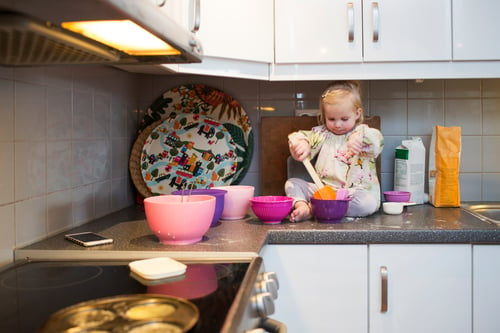
Kitchen Safety With Little Helpers
Children can be safely involved in the kitchen from toddlerhood — and the learning benefits are significant. Here is how to set up for safe, meaningful kitchen time at every age.
The kitchen is one of the richest environments for learning in your home — and one of the few where genuine safety awareness matters from an early age. The good news is that children can be involved in cooking safely from toddlerhood, with the right tasks and a bit of setup. The goal is capable helpers, not cautious bystanders.
Why involving children in the kitchen matters
Kitchen involvement is a form of learning that is hard to replicate anywhere else. Children who participate in food preparation develop:
- ✓Fine motor skills through stirring, pouring, kneading, and peeling.
- ✓Mathematical concepts through measuring, counting, and dividing.
- ✓Science understanding through watching things change — batter becoming cake, milk becoming yoghurt, shapes changing under a knife.
- ✓Food familiarity — children who help make food are significantly more likely to eat it, including vegetables they might otherwise refuse.
- ✓A sense of competence and contribution — the pride of having made something real.
These benefits are worth the mess. And there is always mess.
Age-appropriate tasks
The right task for a young child is one they can do with reasonable success most of the time, with some support. A rough guide:
**Under two:** Washing vegetables or fruit under supervision. Stirring things in a bowl with your hand steadying it. Tearing soft leaves. Watching and being near.
**Two to three:** Pressing cookie cutters. Rolling dough with a rolling pin. Spreading soft things on bread. Sorting vegetables by colour or shape.
**Three to five:** Peeling things with a peeler under supervision. Cracking eggs into a bowl, expecting some shells. Measuring and pouring dry ingredients. Snipping herbs with child-safe scissors.
No task is too small. Being given the job of putting the exactly right number of blueberries on each plate is completely meaningful to a three-year-old.
Setting up for safe helping
A few practical steps make kitchen involvement safer and calmer:
- ✓Use a step stool or learning tower so your child is at a stable working height.
- ✓Move sharp and hot things away from the workspace before inviting them in.
- ✓Establish clear language: this is hot, we look but do not touch is more useful than a long explanation.
- ✓Model what you want: wash your hands, explain what you are doing, invite them to copy.
- ✓Have a simple job ready before they arrive at the counter — something that does not require waiting for you to be free.
KidsHealth NZ has safety guidance specifically for kitchen safety with young children, including tips on stove safety and scalds — one of the most common childhood injuries at home.
Teaching hot and sharp
These two concepts are worth spending real time on, because they require calibrated understanding — not just the word, but the actual meaning.
For hot: let your child get close enough to feel warmth from a warm cup or a resting baking dish without burning themselves. The sensation is a better teacher than the word. Always use the same language: that is hot, we do not touch that.
For sharp: kitchen scissors and child-safe peelers can be introduced with explicit instruction. A butter knife on a soft banana is a good first cutting experience — it gives the feel of using a cutting tool with minimal risk.
Praise careful behaviour explicitly: you held that really steadily — that is exactly right. Children learn safety faster through positive reinforcement than through correction.
The long game
A child who grows up in the kitchen — who knows how to crack an egg, how to use a knife carefully, how to taste and adjust, how to wash up — is a child who will be able to feed themselves and others for the rest of their life. That is a profound practical skill.
The activities library includes a range of simple cooking and food preparation activities suitable for different ages. Many can be done with ingredients you already have. The idea is not elaborate baking projects — it is finding the moment in your ordinary cooking when a small helper can be genuinely useful.
Start simple. Give them real things to do. Accept the mess graciously. The competence they are building is worth every spilled cup of flour.

Written by
Tiny Steps programme team
Part of the Vector Group Charitable Trust Resilience Programme. Tiny Steps shares practical, educational content for whānau in Aotearoa.
Ready for today's tiny steps?
Open Today for five gentle ideas you can try with your whānau.