Indoor forts as emotional shelters
Walk into most children's rooms and you'll find some version of a den — a small enclosed space furnished with soft things. This is not random. Children have a deep instinct to build shelter.
The den instinct
Walk into most children's rooms and you will find some version of this: a blanket draped over chairs, a cushion arrangement behind the couch, a small dark space under a bed that has been furnished with soft things. Children have a deep, cross-cultural instinct to build small, enclosed spaces.
This is not random. Developmental psychologists have long noted that children and adults both tend to regulate better in enclosed, dim, soft-surfaced environments. The scientific term is 'privacy zones' — spaces that reduce sensory input and increase the felt sense of safety. The folk term is a fort. Both describe the same thing.
What a fort does for a child
The fort is not just a game. It serves several real psychological functions:
- ✓It creates a boundary between the child's space and the larger, noisier world of the household. It is a place that is theirs.
- ✓It reduces sensory input. Smaller, dimmer, quieter — all of this is calming to an activated nervous system.
- ✓It gives a sense of ownership and control. Inside the fort, the child decides what happens. This is rare in a young child's life.
- ✓It is a place to go when the world is too big. When everything is too loud, too much, too fast — the fort is a retreat.
Building one together
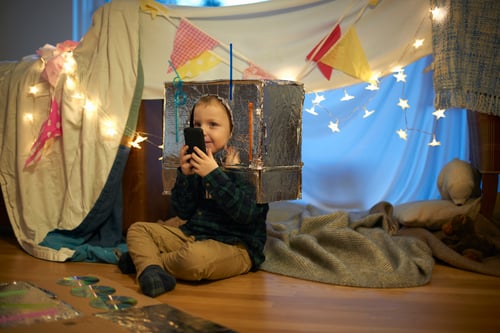
Chairs pushed close together, a dining table with a sheet, a clothes airer draped in blankets, the space behind the couch with a pillow wall — any configuration works. Drape blankets, add a pillow, put a torch or a string of fairy lights inside. You can crawl in together at first, and then leave them to it.
The building itself is often as satisfying as the fort. Let the child direct the design. 'Should the door be here or here?' They will almost always have an opinion.
The emotional function in practice
Some children go to the fort when they are overwhelmed. Some go when they need quiet after a big day at kindy. Some go when a new baby is taking everyone's attention. Some just like the cosiness.
All of these are valid uses of the space. A child who knows how to create a small shelter for themselves when things feel like too much is learning something important about self-regulation: that they can manage their own environment, in a small way, when the environment is too much.
When the fort becomes important
The fort is especially useful during transitions: a new baby arriving, a move, a change in routine, starting kindy. These are the times when young children most need a space that feels unconditionally theirs.
If your child is building forts constantly, or refusing to come out, that is information worth attending to. It may simply mean they are an introverted child who needs a lot of quiet. It may mean something big is happening in their inner world. Both deserve gentle curiosity.
Not just for children
Some adults, if they are honest, also find small enclosed soft spaces calming. The fort is not a childish thing. It is a human thing. Building one for your child — crawling in beside them, sharing the torch and the quiet — is one of the more connecting things you can do on a difficult day.
For more ideas that support emotional wellbeing through play, explore our activities or visit Mental Health Foundation of NZ for family wellbeing resources.
The fort as a family space
Some of the most connected time a family can spend in a fort is doing nothing in particular — lying in it with torches, telling stories in the dark, listening to the sound of the house. The fort creates an unusual equality: in the small space, parents and children are the same size. The ordinary hierarchies of the household temporarily dissolve.
This is worth seeking occasionally. A parent who crawls into the fort without an agenda — not to read, not to play a game, just to be in the small space together — communicates something that is hard to communicate any other way: I am here because I want to be here, with you, in your space.
When the fort is needed most
Pay attention to when your child builds forts or seeks them out. The correlation with stress, overwhelm, or transition is often clear, even if the child doesn't name it. A fort-building phase often tells you something about the emotional weather of the household. Responding to it with warmth — 'can I come in?' — is usually the right move.
For wellbeing resources and emotional support for families, visit the Mental Health Foundation of NZ or explore our wellbeing activities.

Written by
Tiny Steps programme team
Part of the Vector Group Charitable Trust Resilience Programme. Tiny Steps shares practical, educational content for whānau in Aotearoa.
Ready for today's tiny steps?
Open Today for five gentle ideas you can try with your whānau.