
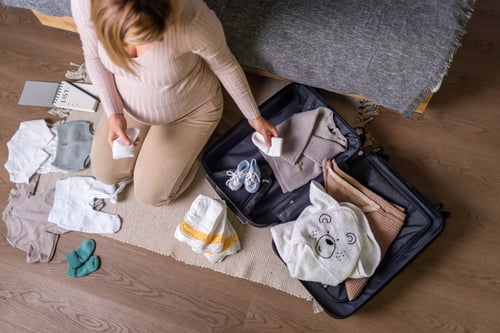
Hospital Bag as a Memory Prompt, Not a Panic Trigger
The hospital bag list can become its own source of anxiety. A more useful frame: this bag is a set of small kindnesses you are packing for yourself.
The List Problem
At some point in the third trimester, the hospital bag list arrives. It may come from a midwife handout, a website, a well-meaning relative, or the algorithm that has clearly identified you as a late-stage pregnant person and is now serving you every conceivable permutation of packing guide.
The lists vary wildly in length and specificity. Some are sensible. Some include items that have not been necessary since 1987. Almost all of them, read in the wrong mood on a tired evening, can make packing feel like a logistics exercise for a minor expedition rather than preparation for a birth.
A different way to think about the bag: you are packing small kindnesses for yourself and your baby, to be opened in a room that is unfamiliar, at a time that will probably be more intense than you expected. The question is not 'have I packed every item on the master list?' The question is 'what will actually help?'
What Actually Helps
The honest answer varies by person, but some things come up consistently:
**For the labour itself:**
- ✓Something that provides comfort: a particular lip balm, a hair tie if you have long hair, a face cloth for your face or forehead
- ✓A phone charger — labour can be long, and music, audiobooks, or simply contact with the outside world matters
- ✓Snacks for both you and your support person that will not be offensive to a sensitive stomach: crackers, dried fruit, nuts, muesli bars
- ✓A change of clothes for the support person, in case they are there overnight
**For the hospital stay:**
- ✓Loose, comfortable clothing — button-front tops if you plan to breastfeed, comfortable underwear in sizes that account for postpartum reality
- ✓Your own toiletries, because hospital soap does not care that your skin is sensitive
- ✓Something from home for the baby: a particular soft blanket, the familiar-smelling item that some parents bring so the baby has a known scent in an unknown environment
**For your mental comfort:**
- ✓A notebook and pen, for the thoughts that arrive at 4am
- ✓Earphones, for privacy and soundscaping
- ✓A photograph of somewhere you love, or someone who cannot be there
For a thorough and reliable list of what hospitals typically require you to bring versus what is provided, KidsHealth NZ has a well-organised and non-alarmist guide.
The Memory Prompt Dimension
Here is the less practical but perhaps more lasting use of the hospital bag: the things you pack become small markers of this particular moment. The specific lip balm. The playlist your partner made. The old soft toy you put in 'just in case' and then felt slightly embarrassed about. The snack that was someone's idea of a joke gift that you put in anyway.
These things tend to take on meaning after the event. The playlist you built for a birth becomes, later, the soundtrack to a significant memory. The blanket you packed for the baby becomes the one they use for years. Packing with this in mind does not require sentimentality — just a small awareness that the bag is a time capsule of sorts, and you are the one deciding what goes in it.
Packing Without Drama
A few practical notes:
- ✓Pack at around 36 weeks, not in a panic at 38. Early packing means early peace of mind.
- ✓Put the bag somewhere visible and accessible, not buried in a wardrobe behind things.
- ✓Tell your support person where it is and what is in it.
- ✓Do not overpack. A bag that is too heavy is a bag you will resent carrying. Two medium bags is better than one enormous one.
- ✓Leave space for what comes home. A baby uses more space than you expect when you add the carseat.
After the Birth
Some people find it useful to note in their hospital bag — on a sticky note or in their phone — one or two things they wished they had. Not as a correction for this time, but as a useful record. If you have a second baby, or if a friend asks what to pack, you will have a genuine answer rather than a reconstructed one.
The bag is a small thing in the larger experience. Packing it as a small kindness rather than a test to pass means you arrive at the hospital with something useful and without the particular weight of having worried about whether you packed it correctly. The resources page of Tiny Steps has further reading for late pregnancy if you want it. But for now: the bag is fine. You are fine. You will remember what matters most.

Written by
Tiny Steps programme team
Part of the Vector Group Charitable Trust Resilience Programme. Tiny Steps shares practical, educational content for whānau in Aotearoa.
Ready for today's tiny steps?
Open Today for five gentle ideas you can try with your whānau.