Food awareness: supermarket scavenger sensory
The supermarket is usually a task to get through. But for a toddler, it is one of the most sensory-rich environments they regularly visit. A small reframe changes the whole trip.
A different way to do the shopping
The supermarket is usually a task to complete as quickly as possible. You have a list, a trolley, and a small person who is either compliant or an active threat to the display stands. The goal is survival, not enrichment.
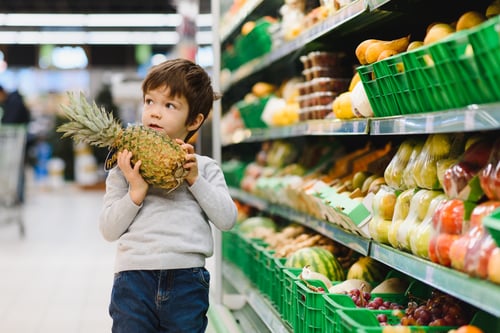
But take a moment and look at it from your toddler's perspective: colour everywhere, the smell of the bakery section, the cold air near the refrigerators, the sound of the PA system, the texture of every kind of packaging known to humankind. For a young child, the supermarket is one of the most sensory-rich environments they regularly visit.
With a small reframe, the supermarket trip becomes a sensory adventure rather than a potential meltdown waiting to happen.
The scavenger approach
Before you leave home, choose one simple task for your child: find something red, find something round, find the bananas, find something that is cold. Give them one job that is real and achievable.
In the aisles, narrate what you are looking at together: 'This one is from Hawke's Bay — that's where apples grow.' 'Smell this — that's coriander, we use it in our soup.' 'This one is the same colour as your jumper.'
Let them touch (safe, non-fragile) packaging. Let them hold the bag of rice or the tin of tomatoes. Let them choose between two options: 'Do you want the green apple or the red one?' This is genuine agency within a container you control.
What it builds
The sensory supermarket experience, done gently and without pressure, builds several things:
- ✓A connection between food and its forms — understanding that food comes in many shapes, textures, and smells, not just how it appears on a plate
- ✓Language. The names of foods, colours, textures. 'Rough', 'smooth', 'heavy', 'squidgy' — these are all real words waiting to be discovered in the vegetable aisle.
- ✓A sense of where food comes from. Seasonal produce labelled by region is a conversation waiting to happen: 'These are grown in the South Island.'
- ✓A feeling of participation. A child who has a job in the supermarket is a co-shopper, not a passenger.
Managing the hard moments
Checkout queues. The confectionery display at precisely toddler height. The moment when they want to push the trolley into the display. These are predictable challenges — you can plan for them.
A small snack before the shop (hungry toddlers and supermarkets are a difficult combination), a simple job to do, and a realistic time limit make for a far better trip than a long, hungry wander.
If they want the thing at the checkout, a neutral 'not today' and a change of subject is often enough. You do not need to explain, negotiate, or apologise for it.
Food awareness as a long game
The habit you are building here — of paying attention to food, noticing what it looks like before it is cooked, knowing where it comes from — is a long-term investment. A child who grows up with food awareness is more likely to be an adventurous and curious eater as they grow. Not because of any single supermarket trip, but because of many ordinary trips over many years.
For more ideas on food and family life, explore our resources or browse this week's activities. Plunket also has helpful guidance on food and nutrition for young tamariki.
Reading labels together
For children who are becoming interested in letters and numbers, the supermarket is a reading environment. 'Find me something that starts with the letter B.' 'How many of those are in the bag?' 'What does it say on the front of the box?'
This is not a formal literacy lesson. It is playful engagement with print in a real environment, which is one of the most natural ways literacy develops.
What NZ-made means
Many products in New Zealand supermarkets carry clear country-of-origin labelling. For older toddlers and preschoolers, 'this one was made in New Zealand' versus 'this one came from far away on a big ship' is a genuine piece of world knowledge. The world is large and interconnected, and the supermarket is a small window into it.
The shared list
A simple drawn list (pictures, not words, for young children) that your child can hold and 'read' during the shop gives them genuine participation in the planning. They chose the item on the list at home, they found it in the shop, they carried it to the trolley. That is a complete loop of agency and responsibility.
Browse our resource section for more ideas on building everyday life skills with young tamariki.

Written by
Tiny Steps programme team
Part of the Vector Group Charitable Trust Resilience Programme. Tiny Steps shares practical, educational content for whānau in Aotearoa.
Ready for today's tiny steps?
Open Today for five gentle ideas you can try with your whānau.