
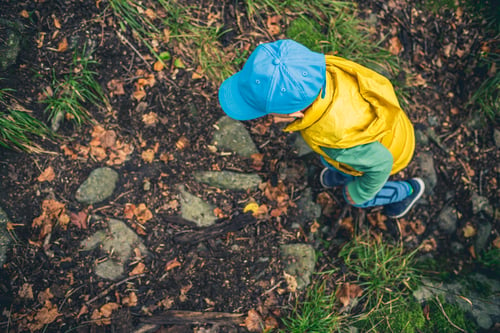
Curiosity walks: collect five questions
Most walks have a destination. This one has a different goal: come home with five questions you couldn't answer. What noticing together does for a child — and a parent.
A walk with a different goal
Most walks with young children have a destination or a purpose — the park, the dairy, the school pick-up. Some walks are just about burning energy, which is valid. But there is a third kind of walk: the curiosity walk, which has one simple rule.
The goal is to come home with five questions you couldn't answer on the walk itself.
Not five answers. Five questions.
How it works
As you walk, pay close attention to what your child notices. They will notice things you have stopped seeing. A crack in the footpath with something growing in it. A bird in a tree you have walked under a hundred times. A drain that makes a particular sound when a car drives over it. A letterbox shaped like a fish.
When they notice something and ask why — or when they look at something for a long time without words — say: 'That's a good question. Let's put that on our list.' Carry a small notebook, or just count on your fingers.
When you notice something yourself, model the curiosity: 'I wonder why that tree has dropped all its leaves but that one hasn't.' Don't rush to answer it. Put it on the list.
Why questions over answers
When adults rush to answer children's questions, they sometimes accidentally teach that the important thing is the answer — not the wondering. Children pick up quickly that questions are just a way to get information, rather than a way of being in the world.
The curiosity walk inverts this. It says: the noticing matters. The wondering matters. We do not need to resolve every question immediately. Some questions we will look up when we get home. Some we will ask someone who knows more than us. Some we might just live with.
This is a different relationship with not-knowing — one that is comfortable rather than anxious. That comfort is one of the most valuable things you can give a child.
What to do with the questions
When you get home:
- ✓Look one up together — in a book, or online, or by calling a grandparent who might know
- ✓Draw a picture of the thing you wondered about
- ✓Write or dictate the questions into a small notebook that becomes a curiosity journal over time
- ✓Leave one unanswered, on purpose, for now
Not every question needs resolution. The list itself is the artefact.
NZ context: what you might find
Aotearoa's particular landscape offers extraordinary material for curiosity walks:
- ✓Tūī calling from a kowhai tree and then flying suddenly away — where do they go?
- ✓A fantail following you through a patch of bush — why do they do that?
- ✓A weta under a piece of loose bark — how long has it been there?
- ✓Pohutukawa roots finding the cliff edge — how do trees know which way to grow?
- ✓The colour of a rock in a stream — what is it made of?
None of these require a science degree to explore with a child. They require attention, which is something you already have.
The habit of noticing
A child who grows up being asked 'what did you notice today?' has a different relationship with the world than one who is asked 'what did you do?' Noticing is an inward act. It builds a sense of the world as endlessly interesting, and of the self as someone capable of finding that interest.
The curiosity walk is just one way to practise this. But it is a surprisingly powerful one.
For more ways to build curiosity into everyday life, explore our activities and today's suggestions in the Tiny Steps app.
The curiosity journal over time
If you keep a small notebook of curiosity walk questions over months, something interesting happens: a record of your child's noticing accumulates. Reading back through it later is a portrait of a mind growing. The questions from last winter ('why is the sky grey?') sit alongside this week's ('why does the creek sound different after rain?').
This is not a project that needs to be maintained perfectly. A notebook that is picked up and used six times over a year is enough. The habit of writing down what you wonder teaches that wondering is worth recording.
On going slowly
The best curiosity walks are slow. Not purposeful-walking slow, but genuinely dawdling slow — the pace at which a two-year-old naturally walks when they are interested in everything. Letting the walk take as long as it takes, without rushing toward a destination, is the condition under which the five questions are most easily found.

Written by
Tiny Steps programme team
Part of the Vector Group Charitable Trust Resilience Programme. Tiny Steps shares practical, educational content for whānau in Aotearoa.
Ready for today's tiny steps?
Open Today for five gentle ideas you can try with your whānau.