
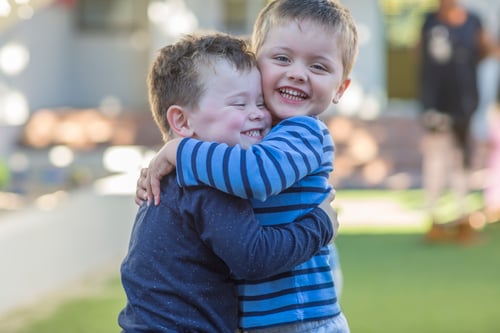
Confidence after a wobble at kindy drop-off
Your child wraps both arms around your leg and says 'don't go.' You have to leave anyway. These mornings are among the hardest in early parenting — and also a sign of something important.
The mornings that break your heart
Your child wraps both arms around your leg. Their lip is trembling. 'Don't go, Mummy.' And you have to leave. You walk to the car and try to compose yourself before the drive to work, wondering if you have just done something wrong.
Kindy drop-off wobbles are one of the most universally difficult parts of early parenting. They hit something primal: the child needs you, you are leaving, and the weight of that sits with you all day.
What the tears actually mean
Separation anxiety is a sign of healthy attachment. Your child cries at drop-off because you matter enormously to them — because the relationship between you is secure enough for them to feel the loss of it acutely.
This doesn't make walking away easier. But it reframes what is happening. This is not a sign that something has gone wrong in your relationship with your child, or in their relationship with kindy. It is a sign that they love you and that they are still building the capacity to manage being apart.
What actually helps at the goodbye
- ✓Keep goodbyes short and warm. Prolonged farewells — the repeated hug, the second goodbye, the lingering at the gate — increase anxiety for both of you. A warm, confident goodbye signals: this is safe, I'll be back.
- ✓Create a small ritual and do it the same way every time. Three kisses, a wave from the gate, a particular phrase. Predictability is calming. Children settle faster when the goodbye is familiar.
- ✓Never sneak out. Children who are snuck out on when they are momentarily distracted become more anxious, not less. They stop being able to trust that you are there. A clear, warm goodbye — even a hard one — is better.
- ✓Tell them what will happen next. Not a long explanation, just: 'I'll pick you up after lunch.' This is a concrete anchor for a child who cannot track time.
- ✓Trust the teachers. Experienced early childhood educators have seen this a thousand times. They know what to do. In most cases, children settle within a few minutes of a parent leaving.
What happens after you leave
Most children who cry at drop-off are happily engaged within five or ten minutes. If you are worried, it is completely reasonable to ask the teachers to send you a quick message once your child has settled. Many will do this without prompting.
The image of your crying child is the last thing you saw, so it tends to stay. But it is usually not the whole story.
The longer arc
The wobbles usually reduce over weeks. What your child is doing, in each hard drop-off, is building a capacity that will serve them all their lives: the ability to manage separation from people they love, to hold onto the internal sense of being loved even when the loved person is not present.
Each time you leave with warmth and come back reliably, you are adding to that capacity. The confident goodbye — 'I love you, see you after lunch, have a great day' — is not a dismissal. It is a lesson in security.
For the caregiver's own heart
The drop-off wobbles can leave a residue of guilt and sadness that lasts all day. If that is you, be honest with yourself about how it affects you. Talk to other parents. Talk to your early childhood centre teachers, who are usually extremely understanding. And if the anxiety around separation is significant — for you or your child — Plunket is a good starting point for support.
For more on building confidence and resilience in everyday moments, visit our milestones section or explore the activities designed for this stage.
What builds over time
The consistency of your goodbye — warm, brief, reliable — accumulates. Over weeks, many children begin to walk in with confidence, turning briefly to wave rather than clinging. This is not because the attachment has weakened. It is because it has been confirmed, over and over: you go, and you come back. The world holds. The separation is survivable.
Some children take longer than others, and that is completely fine. The kindy teachers will tell you if there is cause for concern. Trust them — and trust your child, who is doing hard work every morning that most adults forget they once had to do too.

Written by
Tiny Steps programme team
Part of the Vector Group Charitable Trust Resilience Programme. Tiny Steps shares practical, educational content for whānau in Aotearoa.
Ready for today's tiny steps?
Open Today for five gentle ideas you can try with your whānau.