
Community Gardens and Belonging
Community gardens offer more than food — they offer belonging. Here is how shared growing spaces connect tamariki to the land, to community, and to a sense of where food comes from.
A community garden is more than a place to grow food. It is one of the few remaining spaces in modern urban life where people of different ages, backgrounds, and circumstances come together around a shared purpose — and where children are genuinely welcome and genuinely useful.
What children get from community gardens
The benefits for tamariki who spend time in a community garden are layered:
**Physical:** Digging, carrying, watering, and harvesting are all forms of physical activity with real purpose. Unlike exercise for its own sake, garden work is intrinsically motivated — you are doing something because it matters, and you can see the result.
**Cognitive:** Understanding where food comes from — that a seed becomes a plant that becomes food — is foundational food literacy that many children are missing. The sequencing, the cause and effect, the patience required — these are significant cognitive demands that children meet naturally when they are engaged and interested.
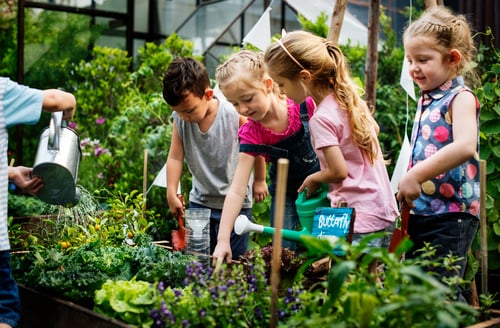
**Social:** Community gardens are social spaces. Regular presence means your child comes to know other adults and other children. They learn to navigate a shared space — waiting for the tool, sharing the watering can, accepting that someone else is working on the patch next to theirs. These are social skills, practised in context.
**Emotional:** The experience of growing something — from seed to harvest — has a particular emotional quality. It requires patience and tolerates failure. Plants die; insects eat things; seeds do not always germinate. These are gentle losses, manageable in scale, that teach children something real about effort and outcome.
Finding community gardens in Aotearoa
New Zealand has a strong community garden culture, particularly in urban centres. Christchurch's regenerative garden movement, Wellington's network of inner-city plots, Auckland's community gardens across many suburbs — these are real and accessible resources for whānau.
The easiest way to find your nearest one is a quick online search for community garden and your area, or asking at your local library or community board. Many community gardens welcome visiting families even without membership. It is worth simply turning up and seeing what is happening.
Some libraries and schools also have their own small garden spaces that run programmes for children. Your local early childhood centre may have connections worth asking about.
How to engage with a community garden
You do not need to be a gardener to engage with a community garden. You need some availability and some willingness to show up. Most community gardens have regular working bees — usually once or twice a week — where anyone can arrive and be given something useful to do.
For families with young children, the most important thing is a low-pressure entry point. Going with another family the first time helps. Having something specific for your child to do — their own small patch, a particular task — helps more.
The activities library has ideas related to food growing and nature that connect naturally with what you might do at a community garden — planting seeds, exploring soil and worms, talking about what different plants need.
Food awareness as belonging
One of the quiet gifts of a community garden is that it makes food visible. Children who have watched a silverbeet plant grow from a seedling, who have picked beans from a vine, who have dug up carrots and washed them at an outdoor tap — these children have a different relationship with food. Not a performative relationship but an embodied one: they know how this grew.
That embodied food knowledge is a form of belonging — to the land, to the community that tended it, to the cycle of seasons that determines what is available. It is food awareness in the deepest sense.
The belonging piece
For whānau who are new to a neighbourhood, recently arrived in New Zealand, or simply looking for community in a busy modern life — a community garden can be an unusually accessible entry point. The activity is shared. The language required is minimal. The hierarchy is flat.
The resources page has links to community organisations across Aotearoa. Your local community board often maintains a list of active community gardens in your area.
Starting small at home
If a community garden is not accessible to you, a small growing project at home achieves many of the same things at a smaller scale. A pot of herbs on a windowsill, a container of tomatoes on a balcony, a tray of seedlings on a kitchen table — children can be involved in all of these, and the same learning and sense of contribution follows.
The measure is not the size of the garden. It is the quality of the attention given to growing things, and to the people doing the growing alongside you.
Community gardens are, at their best, places where belonging is grown alongside the food. Both take time, both need tending, and both reward patience.

Written by
Tiny Steps programme team
Part of the Vector Group Charitable Trust Resilience Programme. Tiny Steps shares practical, educational content for whānau in Aotearoa.
Ready for today's tiny steps?
Open Today for five gentle ideas you can try with your whānau.